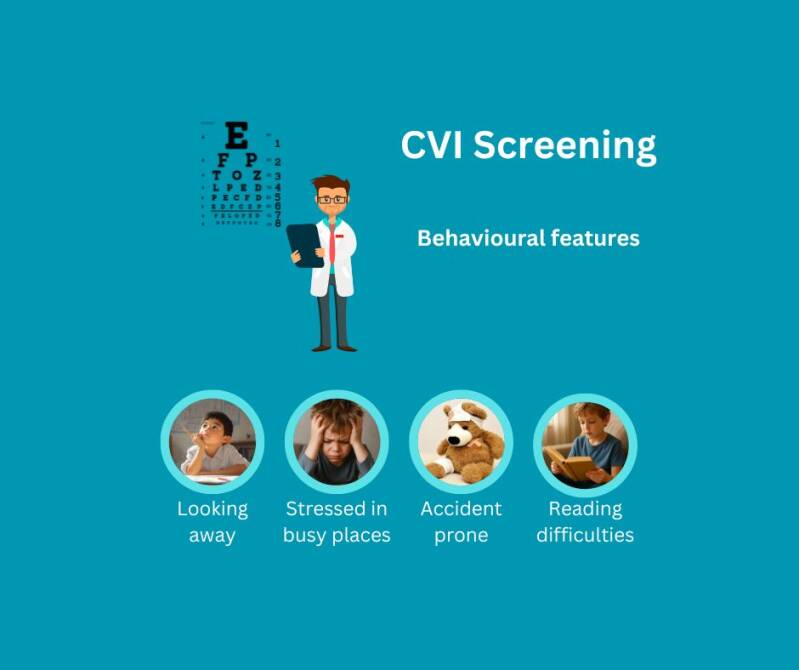
The previous two blogs in this series pointed out that history taking is important in children with visual difficulties. The presence of complications before, during or after birth, and any medical or developmental diagnoses are important elements in paediatric history taking, and can also highlight risk factors for CVI. If a child has visual difficulties, which cannot be explained by their eye condition, a CVI screening assessment is indicated. This can highlight if an in-depth assessment is recommended to identify specific visual difficulties and to offer appropriate adaptive strategies.
I use a short question inventory with non-leading questions for screening purposes as I find this a better way to elicit an unbiased response, compared to closed questions. The questions are designed to seek evidence of specific visual difficulties in a number of domains. For example, one could ask: ‘how does your child go up and down the stairs?’ A parent of a child with a lower field impairment might say that their child is fine going upstairs, but is hesitant going down stairs and prefers to go down on their bum, or holding on to the parent. They may go on to tell you that they hesitate on floor boundaries and struggle with uneven pavement.
For an in-depth CVI assessment, I recommend the use of question inventories, such as the ones developed by Professor Gordon Dutton. Depending on the developmental age of the child as well as the presence or absence of other disabilities, different question inventories are used. The questionnaires determine how children use their vision, rather than what they can see, which is important in the context of diagnosing CVI.
Gordon Dutton’s question inventories can be found here:
If you are interested in CVI screening, I am happy to arrange a Practice Team Training to help you getting started. Patients who screen positive can be referred to me for a comprehensive CVI assessment, either online, or face-to-face in Edinburgh.