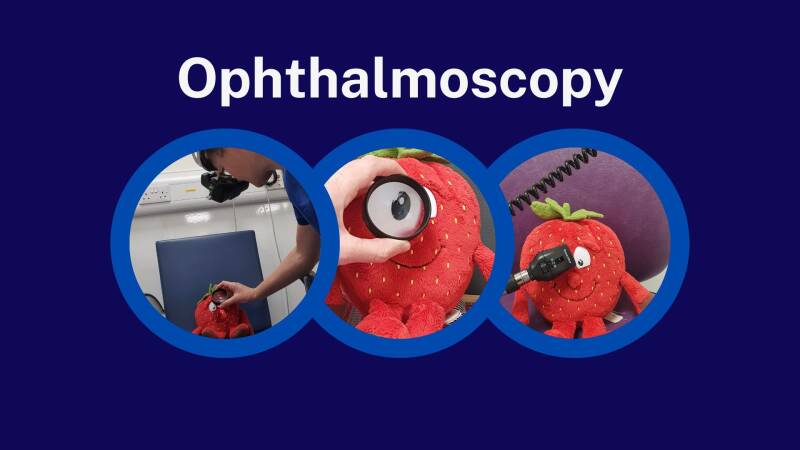
Whilst ophthalmoscopy is a routine procedure for an optometrist, the bright lights may not be readily tolerated by all children. It is therefore important to build trust prior to the procedure. You can reassure the child by telling them that you will do your best to keep them as comfortable as possible and that they can let you know when they need to pause. This way, you are not saying that nothing will hurt, but that you are going to support the child and acknowledge their feelings.
OPHTHALMOSCOPY PROCEDURES
Direct ophthalmoscopy
This technique is great for assessing the optic nerve and macula, but you won’t be able to assess the peripheral retina beyond 2-3 disc diameters. I find that some children tolerate this test better than the binocular indirect ophthalmoscope as it is less bright and some children don’t like the condensing lens being held in front of their eye. Direct ophthalmoscopy is a good choice for assessing children when their pupils are not dilated.
Binocular (or monocular) indirect ophthalmoscopy
This technique allows the practitioner to get a quick overall view of the retina, including the disc and macula, and into the peripheral retina. Some children tolerate this procedure very well, whilst others find the light very dazzling.
PRACTICAL TIPS
Light exposure
It is good to avoid excessive light exposure for all children, and in particular when bright light is not well tolerated. Light exposure can be reduced by reducing the brightness or the diameter of the light-circle, but this may affect how well you can assess the retina. The use of a yellow condensing lens for indirect ophthalmoscopy reduces exposure to blue light without affecting the image clarity.
Power of condensing lens
A standard 20-dioptre lens gives about 3x magnification and a field of view of approximately 45⁰. A higher powered lens gives less magnification, but a wider field than a low powered lens. They can be useful for children with small pupils.
Sleeping child
Ophthalmoscopy can be performed in a sleeping child, and it often does not even wake them up. So, in very young children, it can be good to perform this part of the assessment during their nap-time. They can remain seated/lying in the pram or buggy.
Awake child
My best friend in the paediatric eye clinic is my large-eyed, cuddly Mr Strawberry. I demonstrate all the procedures on Mr Strawberry so that the child knows exactly what will happen next. Here is an example:
Practitioner: Now, I want to show you something funny
(holding the condensing lens in front of Mr Strawberry’s eye) ‘Look, what happened?’
Child: Big eye!!
Practitioner (holding the condensing lens in front of her own eye): What happens to MY eye?
Child: Big eye!!
Practitioner (holding the condensing lens in front of child’s eye): What about YOUR eye?
Child: It’s big!!!!
Practitioner: How do you know?
(laughter)
Practitioner: Now, I’m going to put on my helmet, so I can have a good look at your big eyes. But let’s try it on Mr Strawberry first. Is that ok Mr Strawberry? (Mr Strawberry makes funny sounds)
Practitioner: Mr Strawberry says ‘Yes, of course’
Practitioner (holding the condensing lens in front of Mr Strawberry’s eye and shining the light towards the eye): One-Two-Three, done. Now the other eye: One-Two-Three, done. Was that ok Mr Strawberry? (Mr Strawberry makes funny noises)
Practitioner: Mr Strawberry says ‘It is a bright light, but it is fine for just three counts’.
Practitioner (turning to the child): Now, I would like to do the same with you. I will shine the light for no more than three counts and then you get a break. Shall we turn the lights off?
Practitioner and child together: One-Two-Three, lights off!
(child is looking straight ahead, but shuts the eyes as soon as the light is shone into the eye)
Practitioner: Well done! I can see that the light was very bright for you. Let’s try it again. I’ll make the light a little less bright. This time we’ll try it with the eyes open!
(Practitioner sings to the child, whilst carrying out the procedure)
NB: I often sing to the children during the procedure as it helps them to relax and focus. I also communicate through song. For example, I’ll sing ‘Now look into my light so I can see, I can see, I can see; Look into my light so I can see, I can see your eyes’ (tune: The Wheels on the Bus)
NB: It is important to shine the light for no more than three seconds (even if no view was obtained), so the child can trust that the practitioner does exactly what they expected. The procedure can be repeated until the findings can be recorded. If you need more seconds, you can of course agree this with the child. Some children like the procedure to be demonstrated on their own cuddly toy or their parent before they are ready for their own eyes.