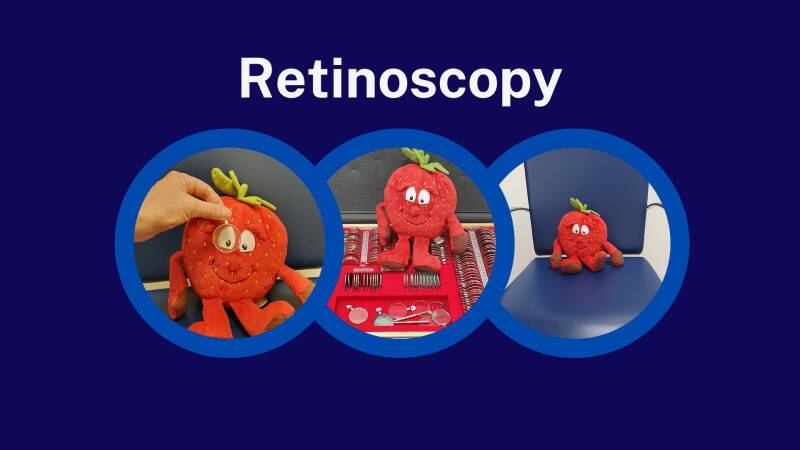
I find it extremely rewarding to engage with children in a clinical setting, especially when the parents do not take for granted that their child will cooperate well. Assessing children is not always easy, but with the right approach, most children can be assessed successfully. Children often thrive when there is a relationship of trust, when they know what to expect and when they enjoy the activities.
TOP TIPS FOR THE PROCEDURE
Repeat-refraction
If children already wear glasses, a quick look at the retinoscopy reflex over the glasses will tell you if a significant change in refractive error is expected. The previous prescription can be used as a guide.
Dull reflex
If you see a dull reflex, especially in the presence of low visual acuities, this may indicate media opacity OR a high refractive error. It is worth trying lenses in large steps to quickly find the approximate prescription before fine-tuning in smaller steps.
Cylinder Axis
I find it easier to see the orientation of the cylinder axis when I use plus-cylinders. Once one meridian is neutralised, you can easily find the axis for the plus cylinder by looking at the orientation of the line that is not yet neutralised (you’ll see a reflection line moving in the same direction as your retinoscope).
Trial frame or no trial frame?
I often perform retinoscopy without a trial frame to minimise discomfort during the procedure. If you decide to do this, I recommend holding the lenses where you would expect the spectacle lens to be positioned. For estimating the orientation of the cylinder axis, you may want to stick an astigmatism fan chart to the wall behind the child as a reference point. Another way to fine-tune the orientation of the cylinder axis, is to briefly put the trial frame on the child at the end of the procedure.
Drops or no drops?
Before you carry out retinoscopy, you need to decide if cycloplegic drops are required. For example, in children with suspected accommodative esotropia, cycloplegia is indicated and the full plus prescription is usually given. In children with suspected accommodation lag, cycloplegic drops would prevent the practitioner from assessing accommodative function. One also needs to consider the discomfort, and in some cases, trauma, children experience from getting drops instilled. Some children are extremely upset after drop instillation and do not tolerate further testing. Therefore, it is important to consider how the instillation procedure can be managed in such a way as to cause minimal upset. Sometimes, it can be helpful to do dry retinoscopy on the first occasion, followed by cycloplegic assessment on a later date. Hospital optometrists can hand out cycloplegic drops for instillation at home prior to the appointment.
Sleeping child
Retinoscopy can be performed in a sleeping child, and it often does not even wake them up. So, in very young children, it can be good to perform this part of the assessment during their nap-time. They can remain seated/lying in the pram or buggy.
INTERACTIONS WITH CHILDREN
Children thrive on predictability and routines. In the eye care setting, routines and predictability can help a child feel more in control and less anxious. I demonstrate every test on Mr Strawberry before testing the child’s eye in order for the child to know exactly what will happen next. Before switching the lights off, the child is asked to clap and count to three. This way, the dark room is fully anticipated. Retinoscopy is demonstrated on Mr Strawberry first with accompanying sound effects to make it more fun. It is explained to the child that they can indicate if they feel uncomfortable, so that they know that the test will be paused when they need this. The interaction may go like this:
Practitioner: (with a big smile and a gentle voice) Hello [child’s name]. How are you today?
Child: (clinging to parent)…
Practitioner: My name is Cirta and this is Mr Strawberry. He is my best friend. Do you want to give him a ‘high five’?
Child: (gives Mr Strawberry a high five and smiles)
Practitioner: Hello [child’s name]. Today, the most important thing for me is to keep you happy. I would like to have a look at your eyes, but I want you to be comfortable. Mr Strawberry loves getting his eyes tested. So I will show you everything on Mr Strawberry first, so you know exactly what will happen next. Is that ok? (practitioner shows ‘thumbs up’ sign)
Child: (thumbs up and nodding)
Practitioner: We need to turn the lights off first. Do you think you can help me? We clap and count to three and the lights will go off
(child and practitioner clap and count, practitioner switches lights off, reaches for retinoscope and turns to Mr Strawberry)
Practitioner: Mr Strawberry, are you ready?
Mr Strawberry: (makes funny noises)
Practitioner: Mr Strawberry says ‘Yes!’
(practitioner sweeps the light across Mr Strawberry’s eyes, saying ‘swoosh-swoosh, swoosh-swoosh’)
Practitioner: Was that ok, Mr Strawberry?
Mr Strawberry: (makes funny noises)
Practitioner: Mr Strawberry says ‘Yes!’
(practitioner turns to child)
Practitioner: Do you think you can do this? Are you ready?
Child: Yes
(practitioner sweeps the light across child’s eyes, saying ‘swoosh-swoosh, swoosh-swoosh’)
Practitioner: Was that ok?
Child: Yes
Practitioner: I’m going to do it again. This time I’m holding a lens in front of your eye
(practitioner demonstrates the procedure on Mr Strawberry, then turns to child)
Practitioner: Are you ready?
Child: Yes!
(Practitioner carries out the procedure whilst singing to the child)
NB: I love singing to children and I use it to help children staying calm and focussed. For example, the child can be asked to look at the light by singing ‘Now look into my light and look into my light, hey-ho the derry-ho, and look into my light; You’re doing very well, you’re doing very well, hey-ho the derry-ho, you’re doing very well; we’ll do it all again, we’ll do it all again, hey-ho the derry-ho, we’ll do it all again’ (Tune: A Farmer in the Dell)