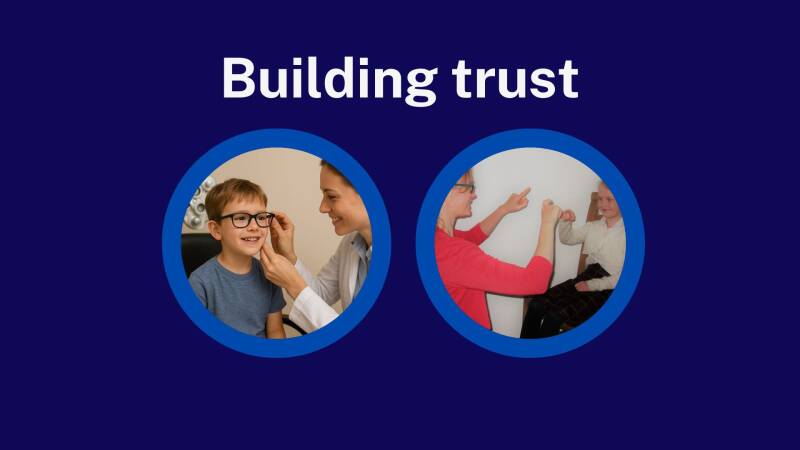
Some children find it easy to trust a practitioner in a clinical setting. Other children hesitate to interact with a stranger. There are many reasons why a child might struggle. For example, a child may find entering new surroundings or meeting new people daunting. Or a child may be reminded of previous negative experiences, making them feel anxious.
First impressions
The child’s first impressions start in the waiting area. How do we meet and greet the child? Do we address the child with a smile and a gentle voice? Or do we greet the parent first, making the child feel less important? What if a child is very shy? Do we allow them to explore the surroundings and settle in before we commence the testing? Some children are not ready straight-away. They may need a bit of time to settle in and they tend to cooperate better when we allow them to take their time.
Acknowledging the child’s feelings
Some children hide under the parent’s chair as soon as they enter the room. Rather than insisting on the child sitting on the designated chair, we could get down to the child’s level and say: ‘I can see that you are not ready for the test. That is no problem. Is it alright if I ask your Mum a few questions first? We can try it a bit later.’ The child usually starts to feel better and will appear from under the chair without any upset. Or the practitioner can say: ’I can see you’re feeling a bit anxious. Can you tell me what you’re worried about?’. This gives the child the opportunity to express their concerns and the practitioner to reassure the child.
Honesty
Eye drops and bright lights are unpleasant for most children and it is therefore understandable that some children are anxious about the anticipated discomfort. This is sometimes exacerbated when practitioners have been dishonest in the past, saying ‘these drops won’t hurt’, when they know that the drops do sting. It is better to be honest about the potential stinging sensation before the drops are instilled and agree with the child how best to manage the situation. If children are sensitive to bright lights, the practitioner can reassure the child by telling them that they will do their best to make the assessment a positive experience. This way, the practitioner does not say that nothing will hurt, but that they are going to support the child and acknowledge their feelings.
Giving praises
I like to praise the child for everything they are doing well, rather than to focus on what went wrong. For example, when I try to instil eye drops and the child reacts by shutting their eyes, I could say: ‘Well done for giving it a go. Now let us try to do it again with your eyes open!’.
Predictability
Children thrive on predictability and routines. In the eye care setting, routines and predictability can help a child feel more in control and less anxious. I always demonstrate every test on Mr Strawberry (my cuddly toy), or the parent, before testing the child’s eye. This way, the child knows exactly what will happen next. Before switching the lights off, I ask the child to clap and count to three. Children love to participate by ‘magically’ controlling the room lights.
Fun
I love creating a bit of fun with children attending my eye clinic, and it leads to better cooperation. There are many ways to make an assessment interesting and fun for a child, and I would encourage practitioners to experiment what way works for them. Some practitioners use magic tricks, others use jokes or funny games, or are perfectly happy to act a bit silly to keep the child interested. I particularly enjoy incorporating songs and music into my routine, and I like the imaginative conversations with children. Fun is important, but it needs to go hand-in-hand with moments of focussed attention. The practitioner needs to communicate clearly when it is time for laughter and when cooperation is expected.
Enjoy your paediatric eye clinic!