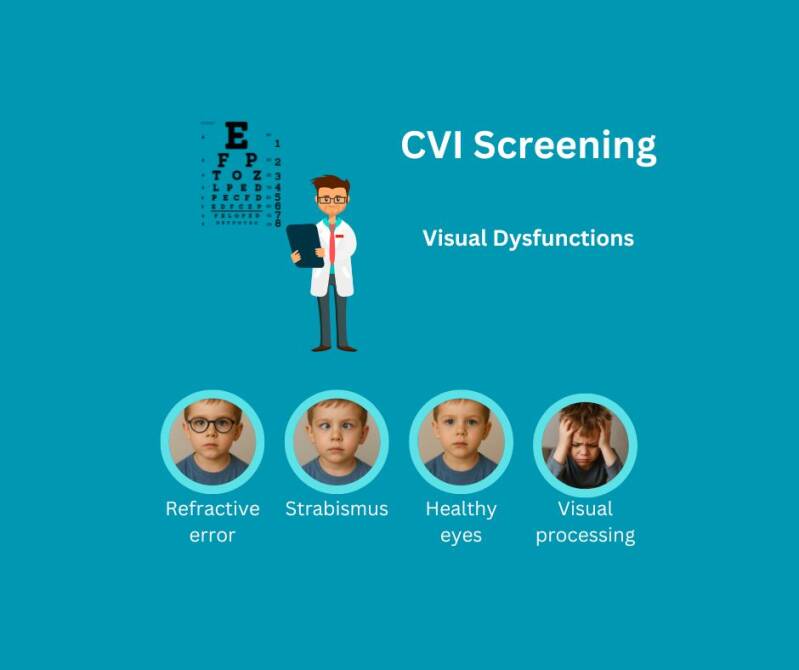
When a child attends for an eye examination with visual difficulties, it is important to rule out ocular causes before these difficulties can be assigned to neurological or neurodevelopmental causes. In this blog, my focus is not the routine eye examination, but rather the elements of the sight test that deserve extra attention when CVI is suspected. Additionally, I will provide an overview of dysfunctions related to higher visual processing.
Eye examination
Children with CVI may present with visual dysfunctions which can be identified and assessed during a routine eye examination. These are:
Reduced best corrected visual acuity (especially crowded)
Abnormal fixation, smooth pursuit and saccadic eye movements
Nystagmus
Strabismus and amblyopia
Reduced stereopsis
Refractive error
Impaired contrast sensitivity/ colours appear faded
Visual field impairments (especially lower field impairment, but also hemianopia and quadrantanopia)
Optic atrophy
Additionally, in children with CVI, visual dysfunctions can occur as a result of ventral stream or dorsal stream dysfunction.
Dorsal stream dysfunction
The dorsal stream network runs from the occipital lobe to the parietal lobe and is sometimes referred to as the WHERE pathway. This network allows us to move freely in three-dimensional space without conscious effort. Children with dorsal stream dysfunction might experience the following visual dysfunctions:
Optic ataxia, also known as impaired visually guided reach. Affected children have difficulties with accurate reach or grasp or with judging the height of steps or the spatial location of objects
Dyskinetopsia, also known as impaired motion perception. Affected children experience difficulties seeing or judging the speed of moving objects. This applies to judging the speed and direction of traffic, and difficulties interpreting rapid gestures or facial expressions and rapid classroom demonstrations. Affected children often find it difficult to engage in team sports with a lot of movement, especially when this involves throwing and catching a ball. Social situations can be overwhelming, leading to withdrawal.
Simultanagnosia is the term used to describe impaired ability to perceive the visual scene in its entirety. Affected children tend to have a restricted field of view, which moves about outside their control. Their symptoms tend to be worse in crowded or cluttered surroundings. Reading can be difficult, especially when there is a lot of information on the page, or the text is not spaced out.
Visual inattention refers to impaired ability to attend to elements in a portion of the visual field. This can be on one side of the body (hemi-inattention) or in the lower part of the visual field (lower field inattention) and is not always detected with automated perimetry. In competitive attention, a child does not notice items on one side if there are competitive stimuli on the other side of their visual field.
Ventral stream dysfunction
The ventral stream network runs from the occipital lobe to the temporal lobe and is sometimes referred to as the WHAT pathway. One can think of it as a visual library, where previously seen objects, places and faces, are stored. When seeing the object, face or place the next time, a match is found and recognition takes place. Children with ventral stream dysfunction might experience the following visual dysfunctions:
Object or shape agnosia refers to impaired recognition of objects or shapes. Affected children may struggle with pictures on vision charts, or in picture books.
Prosopagnosia is a term used for impaired recognition of faces. It affects social interactions and children may not seek eye contact.
Topographic agnosia is impaired recognition of places and routes. This applies to way finding outside, as well as in the house or school.
A visual function assessment can reveal risk factors for CVI and act as a red flag for further investigation. In my next blogs, I will consider other risk factors, such as birth, medical and developmental history, and behavioural differences which can be observed in some children with CVI.
For more information about CVI screening and Practice Team Training, contact Cirta Tooth: