‘What is the leading cause of sight impairment in children in Western countries?’
I like to pose this question to new colleagues and students in the hospital eye service, as most eye care professionals are unable to answer this question. The answer is cerebral vision impairment (CVI). What follows next is usually a mini lecture about the causes of CVI, the risk factors for CVI, how CVI can be identified, and what can be done to support children with CVI.
This series of blogs is for anyone who wants to get a basic understanding of CVI. I am hoping to get more practices interested in screening for CVI, so that more children can receive appropriate support.
We’ll start off with a couple of frequently asked questions to arouse your interest.
What is CVI?
CVI refers to brain-related visual difficulties. The majority of affected children have normal eye test results, but experience visual difficulties, which lead to ‘clumsiness’, difficulties with reading, concentration issues, social withdrawal and sensitivity to crowded, busy or noisy environments.
The nature and severity of visual difficulties varies between children. CVI commonly affects visual processing speed, movement perception, visual attention, visual memory and simultaneous processing.
How many children are affected?
Around 1 in 30 children in mainstream schools and 1 in 4 children with additional support needs have a degree of brain-related visual difficulties. Whilst support can be offered to children, regardless of the severity of their visual difficulties, not every child with brain-related visual difficulties will be diagnosed as having CVI.
Who is at risk?
The underlying cause for visual processing difficulties is not always known for every patient. Children with premature birth, neurological and neurodevelopmental conditions (‘neuro-diversity’) are particularly at risk.
How can affected children be supported?
As a highly specialised Low Vision and CVI Optometrist, I have the necessary knowledge and experience to provide an in-depth CVI assessment, which includes practical advice and a comprehensive report for the children, their parents, carers and teachers. I offer assessments online and in-person (in Edinburgh)
How can you be involved?
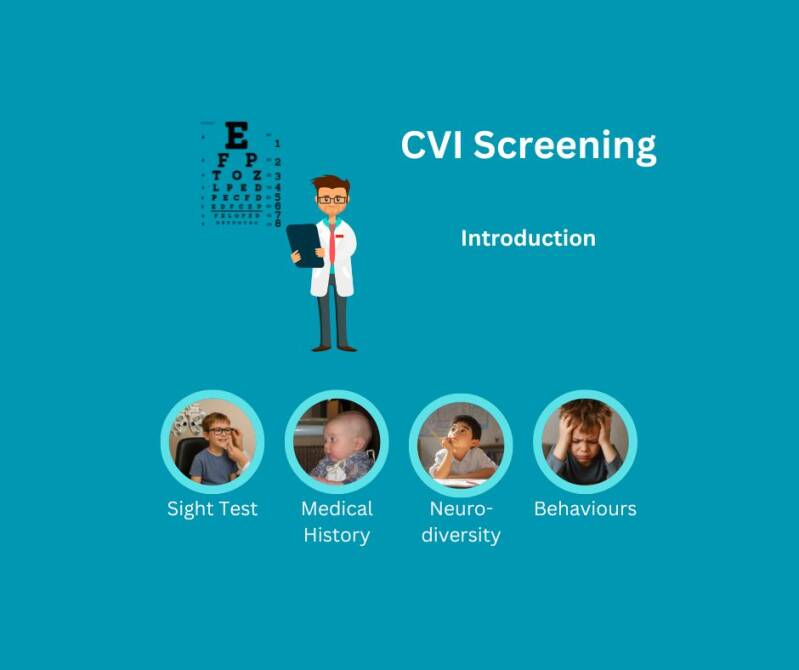
I invite you to get involved in screening for CVI in your practice, offering your patients a unique service with a clear referral pathway for high quality specialist care. The screening involves completing a short questionnaire (parents) and providing me with some details from the sight test. Based on these findings, I can advise you if the patient is likely to benefit from an in-depth CVI assessment. Additionally, children can be asked to complete the Austin Assessment if they have access to an Ipad.
Can a person with CVI be certified for vision impairment?
Certification and registration can be considered for patients with CVI. Read about this in this blog:
Practice Team Training
If you want to know more about this, you can watch a short video:
Or you can contact me for a Practice Team Training